Durban High Court HVAC Upgrade
Energy-Efficient Climate Control for a National Landmark
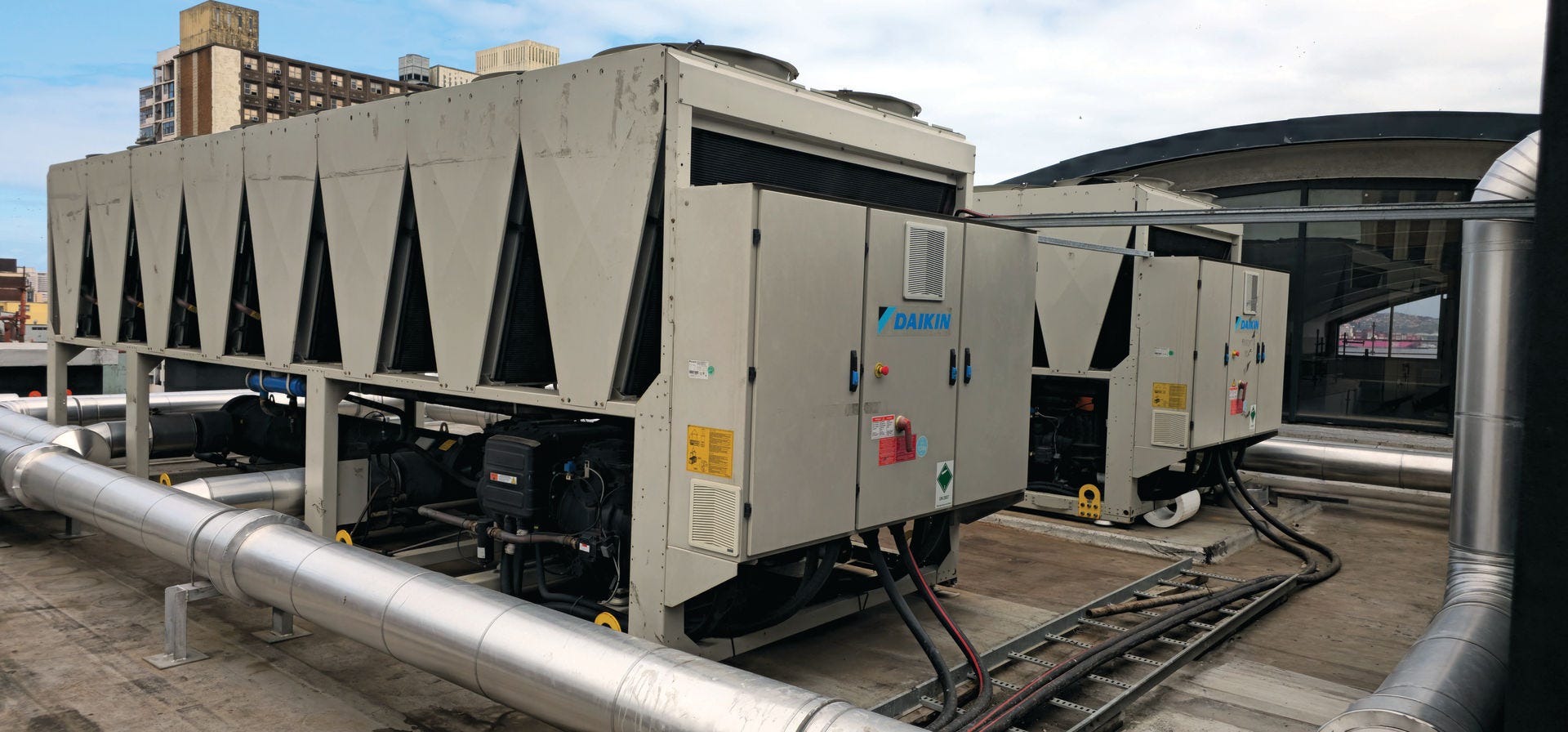
The Durban High Court, a 115-year-old national key point overlooking Durban’s seafront, is currently undergoing a landmark R1-billion redevelopment led by the Department of Justice and Constitutional Development.
This large-scale modernisation required far more than a routine HVAC replacement. It demanded a future-ready, energy-efficient climate control solution capable of serving newly constructed facilities alongside a protected heritage structure – all within Durban’s highly corrosive coastal environment.
Daikin South Africa is proud to have supplied high-efficiency water-cooled chillers for the project, delivering a centralised chilled-water system that now forms the backbone of the new court and administrative buildings.
Project Overview: Commercial HVAC Solution for Durban High Court
Location: Durban, KwaZulu-Natal
Project Type: Government infrastructure redevelopment
Scope: Hybrid HVAC system (Chilled water + VRF)
Primary Equipment: Water-cooled chillers
Client: Department of Justice and Constitutional Development
This redevelopment demonstrates how our energy-efficient HVAC systems can support:
Public-sector infrastructure upgrades
Heritage building preservation
Coastal corrosion protection
High-occupancy indoor air quality compliance
Long-term operational resilience
The HVAC Challenge
The Durban High Court redevelopment presented complex engineering requirements:
1. Hybrid HVAC Integration
Central chilled-water plant for new buildings
VRF system for heritage sections with structural limitations
Seamless integration across multiple HVAC technologies
2. High-Occupancy Courtrooms
Fluctuating cooling loads
Strict indoor air quality standards
CO₂-based demand-controlled ventilation
3. Coastal Corrosion Protection
Durban’s salt-laden air significantly increases corrosion risk, requiring enhanced equipment durability and protective design strategies.
4. Sustainability Requirements
Improved energy efficiency
Reduced water consumption
Lower lifecycle costs
Long-term maintenance planning
The previous cooling infrastructure was hindered by ageing equipment, inefficient ventilation design, and persistent performance limitations that affected both comfort and operational efficiency. As a result, the redevelopment required a next-generation HVAC solution capable of delivering measurable gains in energy efficiency, system reliability, indoor air quality, and long-term environmental performance.
That’s where Daikin South Africa provided a future-focused, sustainable climate solution engineered to meet the demands of a modern public-sector facility.
The Solution: High-Efficiency Water-Cooled Chillers
For the newly constructed court buildings and 11-storey parking and administrative block, Daikin chillers were installed as the central plant solution.
The chilled-water system distributes conditioned air through multiple plant rooms and air-handling units, maintaining controlled environments across:
Courtrooms
Judges’ chambers
Administrative offices
Public circulation areas
Why Daikin South Africa Was Selected
1. Optimised Energy Efficiency
Daikin chillers are engineered for high part-load efficiency – critical in public buildings where cooling demand varies throughout the day. This ensures lower operational energy consumption without compromising comfort.
2. Reduced Water Usage
The project replaced outdated cooling-tower-based infrastructure with modern, energy-efficient chiller technology, significantly reducing water wastage – a major sustainability advantage in South Africa’s water-sensitive climate.
3. Intelligent Indoor Air Quality Control
Integrated CO₂ monitoring and demand-controlled fresh air systems regulate ventilation based on occupancy levels, improving air quality while preventing unnecessary energy expenditure.
4. Built-In Operational Resilience
Backup systems were incorporated to maintain uninterrupted climate control in a high-security judicial facility where downtime is not acceptable.
5. Engineered for Coastal Durability
Given Durban’s harsh coastal conditions, the Daikin equipment selection prioritised corrosion-resistant components and long-term reliability in salt-heavy air environments.
A Hybrid HVAC Strategy for Heritage & Modern Infrastructure
One of the defining features of the project was its dual-system approach:
VRF systems for the heritage building (structural preservation constraints)
Central chilled-water plant for new facilities
This approach delivered:
Scalable cooling capacity
Zonal control flexibility
Improved overall energy performance
Lower lifecycle costs
Streamlined long-term maintenance
The Durban High Court redevelopment highlights how Daikin South Africa integrates modern HVAC engineering with heritage preservation – delivering energy-efficient, high-performance climate control solutions without compromising architectural integrity, operational reliability, or long-term sustainability.
Long-Term Maintenance & Lifecycle Planning
At Daikin South Africa, we understand that government infrastructure demands structured maintenance planning beyond initial commissioning. Therefore, as part of the project strategy, a long-term service plan was implemented to ensure:
Sustained energy performance
Predictable operating costs
Reduced downtime risk
Extended equipment lifespan
For consulting engineers and project managers, this reinforces a critical principle: Energy efficiency must align with serviceability, resilience, and lifecycle cost optimisation.
Sustainable Infrastructure Without Formal Green Certification
Although not formally registered as a green building, the redevelopment – supported by advanced solutions from Daikin South Africa – incorporated strong sustainability principles, including:
High-efficiency chiller technology
Demand-controlled ventilation
Reduced water consumption
Enhanced indoor air quality
Lower energy intensity
By integrating Daikin’s energy-efficient HVAC systems, the project demonstrates how public infrastructure can achieve modern environmental performance standards while preserving historical architecture and ensuring long-term operational resilience.
Commercial HVAC Expertise for Complex Projects
Large-scale developments require more than equipment supply – they require engineering collaboration. Daikin South Africa supports:
Consulting engineers
Project managers
Mechanical contractors
Government infrastructure teams
With solutions including:
Water-cooled chillers
Air-cooled chillers
VRF systems
Packaged rooftop units
Custom commercial HVAC configurations
Frequently Asked Questions (FAQs)
1. What HVAC system was installed at the Durban High Court?
A hybrid HVAC solution was implemented, combining a central chilled-water plant for the new buildings with a VRF system for the heritage structure. This approach allowed energy efficiency, zoning flexibility, and preservation of the historic architecture.
2. Why were water-cooled chillers selected for this project?
Water-cooled chillers were selected for their superior energy efficiency, especially at part-load conditions common in high-occupancy public buildings. They also provide stable performance for large-scale facilities requiring consistent climate control.
3. How do HVAC systems perform in coastal environments like Durban?
Coastal environments expose equipment to salt-laden air, which increases corrosion risk. HVAC systems in these areas must use corrosion-resistant components and protective engineering designs to ensure long-term durability and reliability.
4. What is a hybrid HVAC system?
A hybrid HVAC system combines multiple technologies, such as chilled-water systems and VRF systems, within a single development. This allows engineers to tailor solutions based on structural limitations, load demands, and heritage preservation requirements.
5. How does demand-controlled ventilation improve energy efficiency?
Demand-controlled ventilation uses CO₂ sensors to adjust fresh air intake based on occupancy levels. This reduces unnecessary energy consumption while maintaining optimal indoor air quality in high-traffic environments like courtrooms.
6. Can heritage buildings be upgraded with modern HVAC systems?
Yes. Modern HVAC solutions can be integrated into heritage buildings using low-impact systems such as VRF technology, which requires minimal structural modification while still delivering energy-efficient climate control.
7. Why is part-load efficiency important in government buildings?
Government buildings experience fluctuating occupancy throughout the day. Systems designed for high part-load efficiency consume less energy during non-peak hours, significantly reducing operational costs over time.
8. How can public infrastructure projects reduce water consumption?
By replacing outdated cooling-tower systems with advanced, energy-efficient chiller technology and smart water management strategies, public facilities can significantly reduce water usage and operating costs.
9. Who supplies energy-efficient commercial chillers in South Africa?
Daikin South Africa supplies energy-efficient commercial chillers in South Africa, including high-performance water-cooled and air-cooled systems designed for commercial buildings, government facilities, healthcare institutions, and large-scale infrastructure projects, delivering reliable operation, optimised energy efficiency, and reduced lifecycle costs.
10. What are the benefits of working with Daikin South Africa for commercial HVAC?
Daikin South Africa offers high-efficiency chillers, VRF systems, packaged units, and custom commercial solutions designed for durability, sustainability, and long-term operational performance in complex projects.
Planning a Government or Large-Scale HVAC Upgrade?
If you are developing:
A commercial office complex
Public infrastructure
Healthcare or judicial facilities
A heritage restoration project
Partner with us at Daikin South Africa for energy-efficient, future-ready HVAC solutions engineered for performance, durability, and long-term value. Contact Daikin South Africa today to discuss your project requirements.